Q: Why can’t we eat everything?
A: Surat Al Maidah 5:5 ‘All good, pure foods have been made lawful for you’ "الْيَوْمَ أُحِلَّ لَكُمُ الطَّيِّبَاتُ"
Q: Why do we say 'Bismillah' before eating?
A: Saying 'Bismillah' reminds us to thank Allah for the food we have and to eat in a way that’s mindful and blessed.
Q: Why are pigs considered dirty animals?
A: Because they eat decaying matter, garbage, and dead animals, which helps clean the environment (decomposer)—but makes them unsafe to eat.
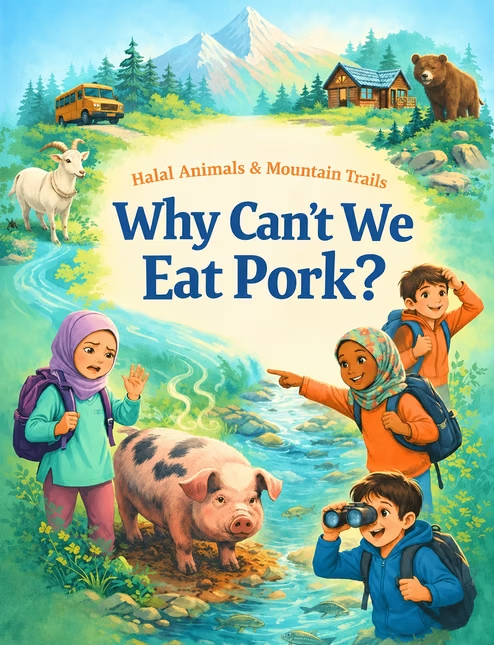
Halal Animals & Mountain Trails: A kid-friendly guide to halal animals
Table of Contents
Why is pork haram…
Muslim parents in the West get food questions early—at school lunches, birthday parties, playdates, and even at the grocery store:
“Why can’t we eat pepperoni?”
“Is fish always halal?”
“If it’s beef, isn’t it automatically halal—why does it need to have the halal logo?”
Halal Animals & Mountain Trails was created to give you a calm, clear way to answer those questions—without awkwardness, fear-based messaging, or vague “because I said so.”
This is not a quick entertainment read. It’s a purpose-built, 92-page children’s book (see book details on this page) designed to help kids understand halal step-by-step, through an outdoor “mountain trail” learning journey they actually enjoy.
What children learn in this book
1) Which animals are halal (and which aren’t)
Instead of dumping rules all at once, Amir and Layla go on a mountain hike and discover animals one by one. With each new animal they encounter, they pause, reflect, and “check” what Allah tells us—by reading the relevant Qur’anic verses and learning how to classify that animal as halal or haram.
This makes the learning feel stacked and layered:
- one discovery at a time
- one clear rule at a time
- repeated in different situations so it sticks
Kids don’t just memorize. They learn how to think when a new food question comes up.
2) Why is pork haram? (Explained for kids, with clarity and respect)
At the heart of Islam, the simplest and most correct answer is:
- Pork is haram because Allah forbade it in the Qur’an. (Qur’an 2:173) and (Qur’an 5:3)
But kids also do better when they have a child-friendly “nature frame” (without claiming science is the reason for the ruling). That’s why the book also anchors what pigs are like in nature:
- Pigs often function like nature’s “cleanup crew”—scavengers that will eat just about anything, including dead animals.
That framing helps kids understand that pigs are not associated with clean eating habits in nature. It anchors the child’s mental image of pigs as an animal with “messy” behaviors—not a clean or noble animal in nature—without turning the conversation into fear or disgust.
(Parent reference if you want it: Britannica Kids overview on pigs))
3) “Not all meat is halal” — what is zabiha (dhabiha)?
A powerful lesson for kids (and honestly, for many adults) is that “halal” isn’t only the animal—halal also includes the process.
This book teaches that:
- eating is not just “what animal is it?”
- it’s also “was it made halal the right way?”
In the Qur’an, Allah instructs believers to eat from what is slaughtered in Allah’s Name, and not to eat from what is not slaughtered in Allah’s Name.
(Qur’an 6:118)
(Qur’an 6:121))
The book introduces zabiha in a child-appropriate way:
- We take a life for food with seriousness, mercy, and Allah’s Name.
- We don’t treat meat like “just another product.”
If you want a deeper parent-level explanation (still practical), this is a solid reference:
SeekersGuidance: The Issue of Halal Meat (Detailed Article)
The Qur’an’s list: when meat becomes not halal (even if it’s a “halal animal”)
One of the most important verses for this topic is the Qur’anic list of how an animal’s death can make it impermissible—even if the animal itself is normally allowed.
The Qur’an forbids animals that died due to:
- strangling
- beating
- a fall
- being gored
- or being partially eaten by a predator
(with an exception if you are able to slaughter it properly before it dies).
(Qur’an 5:3)
In the story, Amir and Layla discover a goat that died from a fall. They wonder if it would be halal anyway—since goat is halal meat—then they discover a key principle: there are specific ways an animal must die in order for its meat to be halal. That moment helps children break the “shortcut thinking” of “beef/goat = automatically halal” and replace it with a clearer rule.
4) Is fish halal in Islam?
In the book, fish becomes a memorable turning point.
Amir and Layla are on the trails and realize they don’t have halal meat available to eat. Then they discover the Qur’anic rule that seafood is permitted, and suddenly the problem has a solution.
They go out fishing, build a small campfire in the woods, and eat the fish they caught—so children don’t just learn “fish is halal” as a line of text. They remember a scene, a feeling, and an outcome.
The verse introduced is:
(Qur’an 5:96 – permission of “game of the sea and its food”)
(Parent reference if helpful: Hadith on seafood permissibility)
5) Can Muslims eat pork in an emergency?
The story introduces the Quran principle that Islam is not designed to crush people in hardship: in genuine necessity, without desire and without exceeding the need, Allah pardons.
(Qur’an 2:173)
But the book also does something important for children’s character:
- it doesn’t treat “emergency permission” like an easy shortcut
- it guides them toward finding alternatives first, problem-solving calmly, and making the best choice available
So kids learn both:
- Islam has mercy in true hardship, and
- Islam trains us to search for better options whenever possible.
A simple way to read this book for maximum impact
If you want your child to internalize halal (not just memorize it), pause during the trail moments and ask:
- “Is this animal halal or haram?”
- “If the animal is halal, what else matters before we eat it?”
- “If we’re not sure, what’s the best next step?”
That trains a lifelong skill: halal isn’t guesswork—halal is thoughtful choices.
If you want the full parent guide (with practical examples), read: Halal Meat for Kids
Q: Why can’t we eat everything?
A: Surat Al Maidah 5:5 ‘All good, pure foods have been made lawful for you’ "الْيَوْمَ أُحِلَّ لَكُمُ الطَّيِّبَاتُ"
Q: Why do we say 'Bismillah' before eating?
A: Saying 'Bismillah' reminds us to thank Allah for the food we have and to eat in a way that’s mindful and blessed.
Q: Why are pigs considered dirty animals?
A: Because they eat decaying matter, garbage, and dead animals, which helps clean the environment (decomposer)—but makes them unsafe to eat.
You can explore our catalog of fully illustrated storybooks here:
👉 Muslim Kids Storybook Catalog
Or you can access our free digital library and find your next favourite bedtime story here:
FAQ
Why is pork haram?
Because Allah explicitly forbade it in the Qur’an. (Qur’an 2:173) (https://quran.com/al-baqarah/173)
Can Muslims eat pork?
Not in normal circumstances. In genuine necessity (without desire and without exceeding need), Allah pardons.(Qur’an 2:173)(https://quran.com/al-baqarah/173)
If it’s beef, isn’t it automatically halal—why does it need a halal logo?
Because halal is not only the animal; it also includes how it was prepared, including slaughter in Allah’s Name and meeting halal requirements. (Qur’an 6:118)(https://quran.com/en/al-anam/118) and (Qur’an 6:121) (https://quran.com/en/al-anam/121)
Is fish halal in Islam?
The Qur’an permits the food of the sea.(Qur’an 5:96)(https://quran.com/en/al-maidah/96)
What if a halal animal dies in the wrong way (like a fall)?
The Qur’an lists specific causes of death that make the meat impermissible (with a limited exception if slaughter can be completed properly in time). (Qur’an 5:3) (https://quran.com/en/al-maidah/3)