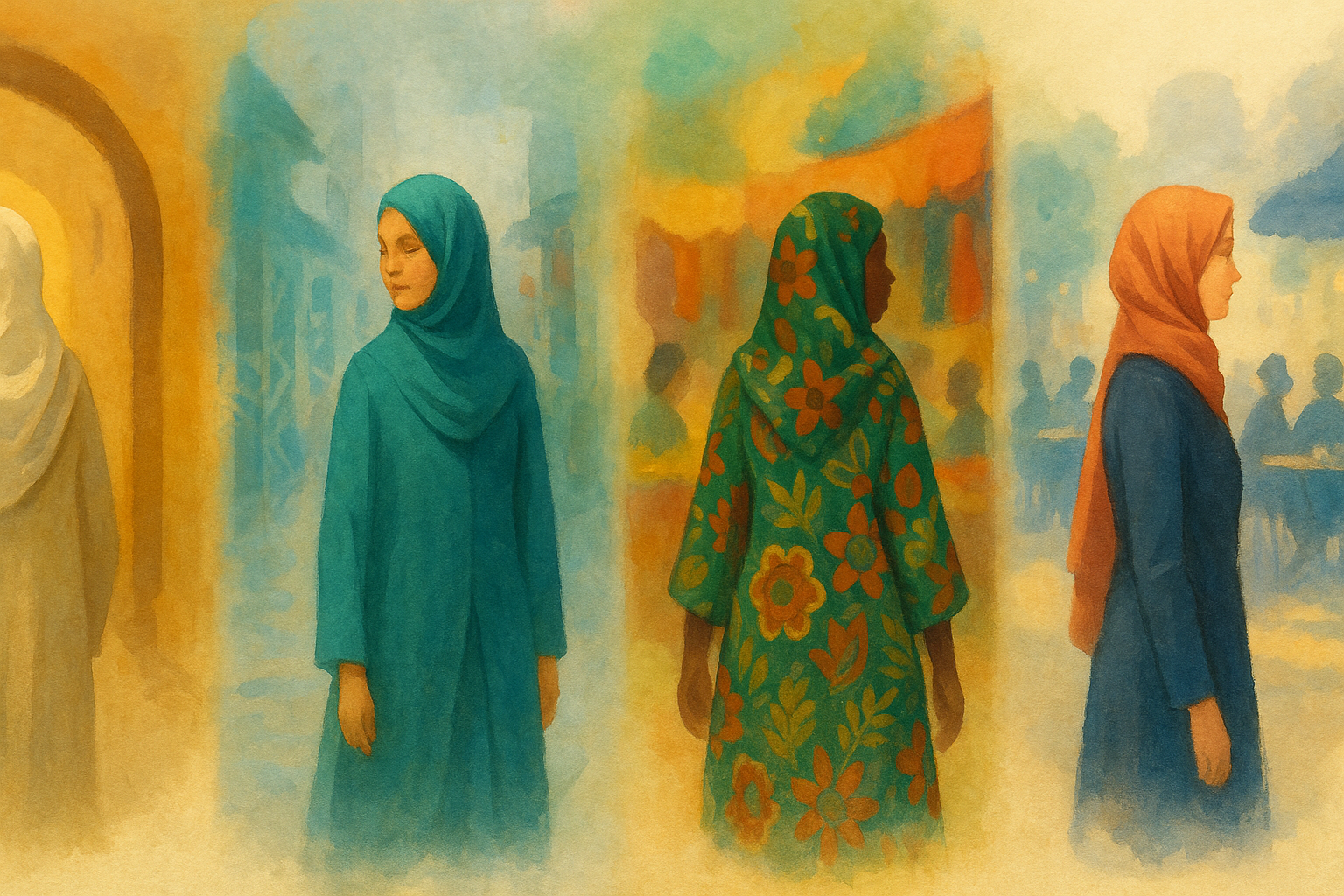
The market was loud with color—linen, cotton, silk—each stall a small theology of cloth. Layla ran a thumb along a bolt of soft sand-colored fabric.
“What do you want this to say?” the tailor asked.
“Not look at me,” she said. “More like see me rightly.”
They both knew the answer wasn’t a cut or a color. In Fez, Jakarta, Lagos, or Paris, modesty speaks with different accents. The question beneath the fabric is older: How do I move through the world as a whole person first—recognized, safe, and dignified?
A little later, Layla unfolded two lines she’d memorized—not as a sketch to copy, but as a compass to follow:
Surah An-Nūr (24:31)
…وَلْيَضْرِبْنَ بِخُمُرِهِنَّ عَلَىٰ جُيُوبِهِنَّ…
“And let them draw their head-covers over their chests …”
Surah Al-Aḥzāb (33:59)
…يُدْنِينَ عَلَيْهِنَّ مِن جَلَابِيبِهِنَّ…
“Let them bring down over themselves a portion of their outer garments …”
Not a diagram. A direction. A way of saying: Don’t let a woman be reduced to display; don’t let her be erased either. Be read for your character before your contours.
Table of Contents
Tradition or religion?
Clothes listen to climate, custom, and city. Principles travel; patterns localize. In one place it’s a loose coat and scarf; elsewhere it’s different fabrics and drape. The quran calls for modesty and recognition, not a single global uniform. Religion sets the direction; cultures handle the tailoring.
With men in charge for millennia, who set the rules?
History is honest: men held most pulpits, pens, and power for a long time. That colored how norms were argued and enforced. But even before scholarly rules, societies used clothing as currency—status, safety, belonging. Some eras pushed display; others prized reserve. The quran’s voice rises above those swings: walk safely, be recognized for who you are, don’t be turned into a commodity.
In hard worlds, display became a marketplace
Where survival and status dominate, bodies become billboards. Men showcased strength to signal provision; women were pushed to showcase allure. That isn’t freedom; it’s barter. The shift the quran invites is away from spectacle as value.
What Islam actually shifted
When the text speaks about worth, it levels the ground:
- At-Tawbah (9:71): وَالْمُؤْمِنُونَ وَالْمُؤْمِنَاتُ بَعْضُهُمْ أَوْلِيَاءُ بَعْضٍ — “Believing men and believing women are allies of one another.”
- Al-Ḥujurāt (49:13): إِنَّ أَكْرَمَكُمْ عِندَ اللَّهِ أَتْقَاكُمْ — “The most noble among you to God is the most God-conscious.”
- Al-Aḥzāb (33:35): إِنَّ الْمُسْلِمِينَ وَالْمُسْلِمَاتِ… — a refrain placing men and women side-by-side in reward and responsibility.
Read An-Nūr 24:31 and Al-Aḥzāb 33:59 in that light and a pattern appears: cover what turns you into a commodity; protect what turns you into a target; let taqwā—not curves—carry your introduction.
So… outdated or ahead?
Back at the stall, Layla chooses that sand-colored cloth. Not to audition for anyone’s approval. Not to disappear. To speak clearly in public space: Parts of me are not for sale. See my mind, my mercy, my work first. In another city, another woman will answer the same call with different tailoring. The direction holds; the styling flexes.
Modern life shouts, show more to be more. The quran replies, be more—whether or not you show more. When hijab is chosen freely and knowingly, it isn’t a step backward. It’s a step out of the old marketplace of display and into a different economy of meaning. And the cloth says exactly what the verses meant it to: walk with dignity; be recognized; move safely; remain whole.
Keep the spirit, not just the script
If this resonates, keep choosing understanding over rule-collecting—return to the verses, the purpose, and the inner compass that turns fabric into meaning.
You can explore our catalog of fully illustrated storybooks here:
👉 Muslim Kids Storybook Catalog
Or you can access our free digital library and find your next favourite bedtime story here:
👉 Read islamic stories for free
FAQ
What does the Quran actually say about hijab and women’s dress?
The Quran emphasizes modesty, dignity, and recognition rather than prescribing a single outfit. Key verses often cited are An-Nur 24:31 (drawing the head-cover over the chest) and Al-Ahzab 33:59 (bringing down an outer garment for recognition and safety). They set principles, not a global uniform.
Is hijab “mandatory” in Islam?
The Quran sets covering + modesty as direction. Across Islamic scholarship, interpretations differ on scope and details (what must be covered, when, and how). Our approach centers conscience, purpose, and context: worth over display, safety over spectacle, and intention over imitation.
Is hijab the same as niqab or face veil?
No. “Hijab” broadly refers to modest presentation (commonly a headscarf covering hair and neck). “Niqab” covers the face (leaving the eyes). Communities and schools differ on the status of niqab; many view it as optional rather than universal.
Is hijab a product of patriarchy?
Power dynamics shaped many social norms, but reducing hijab to patriarchy misses the Quran’s project: detaching a woman’s value from visibility and refusing to price women in the marketplace of attention. Chosen freely, hijab can function as agency—not erasure.
Can hijab look different across cultures and climates?
Absolutely. Religion sets direction; cultures handle tailoring. A modest coat and scarf in Paris, a breathable jilbab in Jakarta, a djellaba and shawl in Fez—same principle, different local expressions.
What about men—does the Quran address their modesty?
Yes. Modesty is not one-sided. The Quran addresses men first (An-Nur 24:30) to lower the gaze and guard dignity. Ethical dress and behavior apply to everyone.
Can a Muslim woman be modest without a headscarf?
Muslim women worldwide practice modesty in diverse ways. Some wear a scarf; others emphasize loose, non-revealing clothing without a headscarf. Communities differ; the shared thread is modesty, dignity, and being seen rightly.
Is hijab outdated in modern life?
Not if you see it as opting out of the “billboard economy.” In a culture that often equates worth with visibility, hijab can be a post-market statement: competence, character, and taqwa over spectacle.
Will hijab limit school, sports, or work?
In most cases, no—fabric, fit, and function solve the practical bits (sports scarves, secure pins, breathable weaves). Policies vary by country and institution; check local guidelines, but many places protect religious dress in public life.
How do I explain hijab to kids without turning it into rules?
Tell a story about dignity and privacy: being recognized for who you are before how you look. Connect it to fairness, safety, and self-respect—then let the wardrobe follow the values.