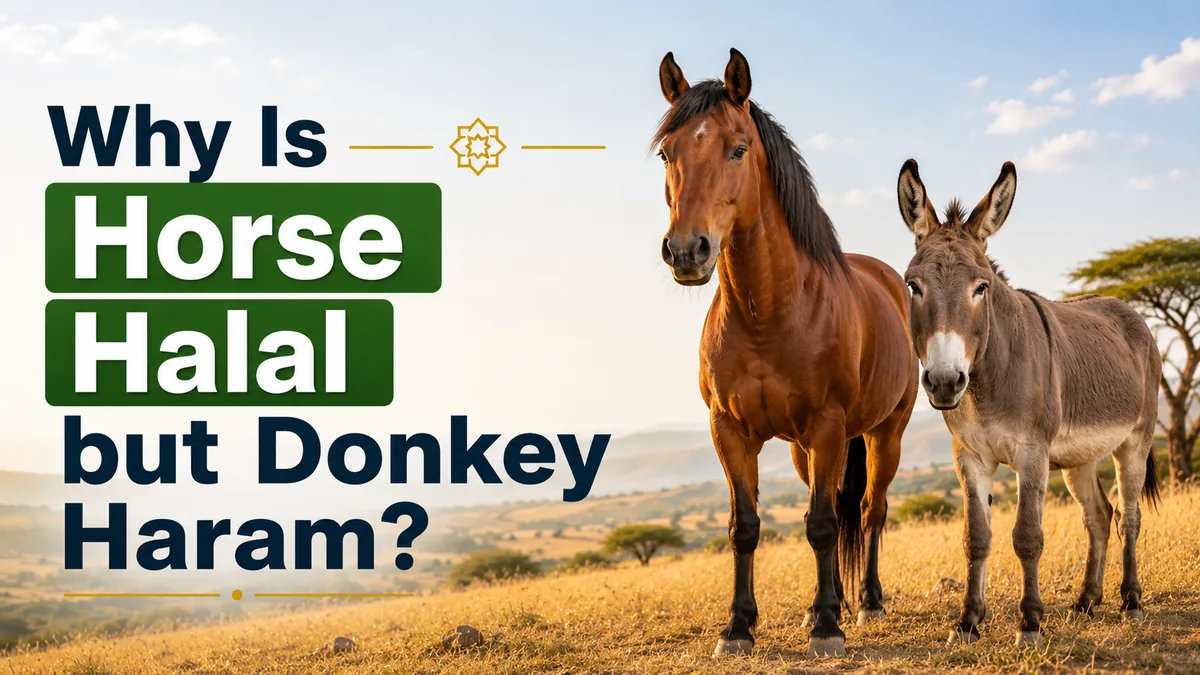
Why Is Horse Halal But Donkey Haram?
This is one of the most distinctive rulings in Islamic dietary law: horse meat is halal (permissible) while donkey meat is haram (forbidden). Although both are herbivorous, non-predatory animals that seem to share identical characteristics, Islamic scholars have ruled that horse and donkey have opposite legal statuses. This ruling comes from authentic hadith sources and Prophetic traditions.
Understanding the Difference
Horses are large herbivorous animals while donkeys are also herbivorous animals. Biologically, they are similar in many ways. Both are non-predatory, both are used for transportation and labor, and both are domesticated. Yet despite these similarities, Islamic law permits one and forbids the other.
The Hadith Evidence: Why Horse Is Halal
The Prophet Muhammad (peace be upon him) explicitly permitted eating horse meat. Sahih al-Bukhari 5476 documents that the Prophet permitted horse meat. Sahih Muslim 1941 states that the Prophet made horse meat lawful and hunting with it is lawful.
Allah states: “And the horses, mules, and donkeys, for you to ride and for adornment…” (Qur’an 16:8)
The Hadith Evidence: Why Donkey Is Haram
The Prophet Muhammad (peace be upon him) explicitly forbade eating donkey meat. Sahih Muslim 1941 directly documents that the Prophet prohibited eating donkey meat and slaughtering it during the Battle of Khaybar. Tirmidhi 1486 confirms this prohibition.
The Prophet made a clear distinction: horse meat is lawful, donkey meat is not. This ruling is explicit and consistent across all major hadith collections.
What Islamic Scholars Say
All four major schools of Islamic jurisprudence (Sunni madhabs) agree on this distinction:
- Hanafi School: Horse meat is permitted, donkey meat is forbidden
- Maliki School: Horse meat is permitted, donkey meat is forbidden
- Shafi’i School: Horse meat is permitted, donkey meat is forbidden
- Hanbali School: Horse meat is permitted, donkey meat is forbidden
This unanimity across all schools confirms the clarity of the ruling. The distinction is not based on biological similarity but on explicit Prophetic guidance.
Why This Distinction Matters
Islamic law is not based solely on logical reasoning about animal characteristics. Rather, Islamic rulings come from the Qur’an and Hadith, and from the guidance of the Prophet Muhammad (peace be upon him). When the Prophet made a clear distinction between two similar animals, Muslims follow that distinction regardless of biological similarities.
This teaches an important principle: Islamic law is based on divine revelation, not human logic. The Prophet’s explicit permission of horse meat and prohibition of donkey meat is sufficient for Muslims to follow, even if we do not fully understand the underlying reasoning.
Practical Application
Horse meat: Permissible when hunted with Bismillah or slaughtered using the Zabiha method. When sourced from halal-certified suppliers, horse meat is lawful to eat. However, it carries the makruh (discouraged) classification in Islamic jurisprudence.
Donkey meat: Absolutely forbidden. No method of hunting or slaughter makes donkey meat permissible. Eating donkey meat violates Islamic dietary law.
Related Articles
Learn more: Is Horse Halal, Is Wild Donkey Halal. These articles explore each animal in detail following Islamic law.
Simple Answer
- Why is horse halal but donkey haram? The Prophet Muhammad (peace be upon him) explicitly permitted horse meat and prohibited donkey meat based on Prophetic traditions.
- Is this based on animal biology? No. Both are herbivorous, but Islamic law follows Prophetic guidance, not biological reasoning.
- Do all Islamic scholars agree? Yes. All four major schools of Islamic jurisprudence agree on this distinction.
- Can you eat horse? Yes, when properly hunted or slaughtered, though it is makruh (discouraged).
- Can you eat donkey? No. Donkey meat is absolutely forbidden.
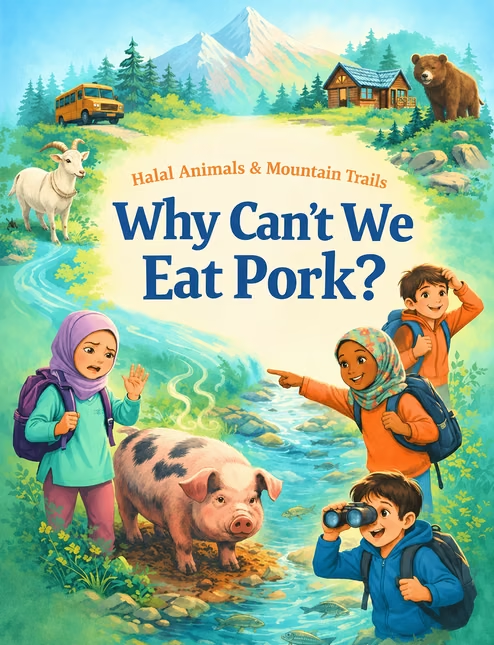
Teaching Halal Animals to Children?
Our book Halal Animals & Mountain Trails introduces halal and haram animals in a child-friendly way with Islamic reminders.
Q: Why can’t we eat everything?
A: Surat Al Maidah 5:5 ‘All good, pure foods have been made lawful for you’ "الْيَوْمَ أُحِلَّ لَكُمُ الطَّيِّبَاتُ"
Q: Why do we say 'Bismillah' before eating?
A: Saying 'Bismillah' reminds us to thank Allah for the food we have and to eat in a way that’s mindful and blessed.
Q: Why are pigs considered dirty animals?
A: Because they eat decaying matter, garbage, and dead animals, which helps clean the environment (decomposer)—but makes them unsafe to eat.
Frequently Asked Questions
What is the primary source for this ruling?
Sahih Muslim 1941 and Tirmidhi 1486 document the Prophet's explicit permission of horse meat and prohibition of donkey meat. This is the primary source for this distinction.
Do all Islamic schools agree on this distinction?
Yes. All four major schools of Islamic jurisprudence (Hanafi, Maliki, Shafi'i, Hanbali) unanimously agree that horse is halal and donkey is haram.
Is this distinction based on animal biology?
No. Both are herbivorous, but Islamic law follows Prophetic guidance, not biological reasoning. The distinction comes from explicit hadith sources.
Can any slaughter method make donkey meat halal?
No. The prohibition on donkey meat is absolute and based on Prophetic tradition. No hunting or slaughter method makes donkey meat permissible.