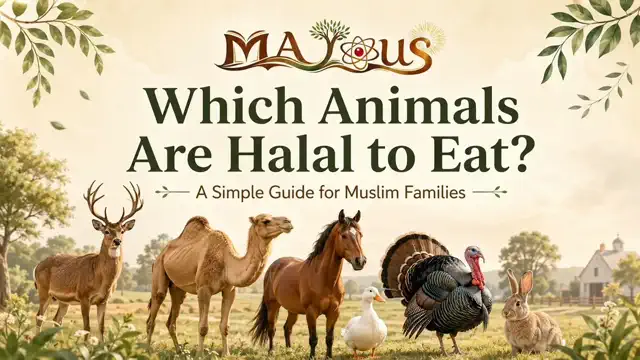
Many parents and children ask us: “Is this animal halal?” Some answers are clear and simple. Some need more explanation. And some animals fall into a gray area where scholars may differ.
This page gathers all of Mayous’s halal animal guides in one place. It’s a hub to help you find the answer quickly—and to understand why halal rules exist in the first place.
Whether your child is curious about animals at a farm, in a book, or on a hiking trip, you’ll find the answer here.
Q: Why can’t we eat everything?
A: Surat Al Maidah 5:5 ‘All good, pure foods have been made lawful for you’ "الْيَوْمَ أُحِلَّ لَكُمُ الطَّيِّبَاتُ"
Q: Why do we say 'Bismillah' before eating?
A: Saying 'Bismillah' reminds us to thank Allah for the food we have and to eat in a way that’s mindful and blessed.
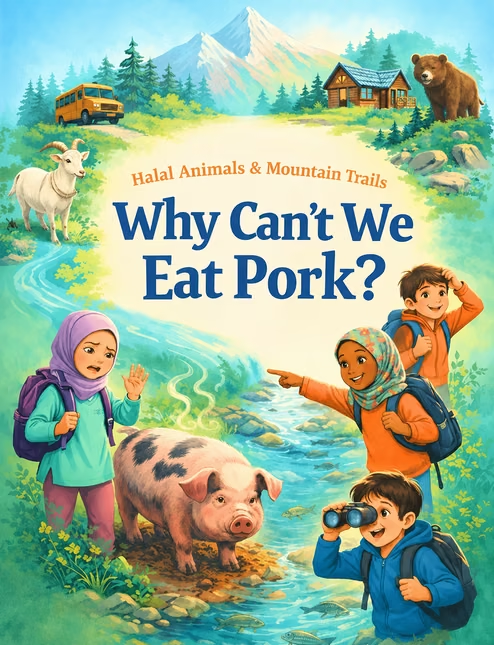
Q: Why are pigs considered dirty animals?
A: Because they eat decaying matter, garbage, and dead animals, which helps clean the environment (decomposer)—but makes them unsafe to eat.
The Simple Rule: Halal Meat Is About the Animal and the Method
Here’s the foundation: halal depends on two things—the animal itself, and how it’s treated.
First, the animal must be halal by type. Some animals are naturally halal (like sheep and deer). Some are naturally haram (like pigs and predators). Some need more thought (like certain birds or unusual game).
Second, even a halal animal becomes haram if it’s not slaughtered or hunted properly. Here’s why:
- The animal must be hunted or slaughtered with a sharp knife, causing quick death.
- Allah’s name (Bismillah) must be mentioned.
- The meat must be drained of blood.
If an animal is found already dead, it is not halal. No matter how fresh it looks, Islamic law is clear: we must see the animal alive and know how it died.
If hunted, Islamic hunting rules matter. A Muslim can use a trained dog or falcon to hunt, but it must kill quickly. Traps are controversial among scholars.
Keep these principles in mind as you read about each animal.
Halal Wild Animals and Grazing Animals
These are the herbivores and natural prey animals. Most are halal when hunted or slaughtered properly.
- Is Caribou Halal? — A North American grazing animal, halal when properly hunted.
- Is Antelope Halal? — A fast, graceful herbivore found in Africa and Asia, halal.
- Is Gazelle Halal? — A slender desert herbivore mentioned in Islamic texts, halal.
- Is Rabbit Halal? — A small, peaceful herbivore, halal when hunted properly.
Halal Birds
Many birds are halal, but not all. Predatory birds like eagles and hawks are haram. Scavenger birds like crows and vultures are haram. But most farmyard birds and game birds are halal.
- Is Duck Halal? — A common waterfowl, halal.
- Is Goose Halal? — A larger waterfowl, halal.
- Is Turkey Halal? — The common farmyard bird, halal.
- Is Wild Turkey Halal? — The wild cousin of farm turkey, halal when hunted properly.
- Is Quail Halal? — A small game bird, halal.
- Is Pheasant Halal? — A colorful game bird, halal.
- Is Partridge Halal? — A small, speckled game bird, halal.
- Is Pigeon Halal? — A common city bird, halal.
- Is Dove Halal? — A gentle bird similar to pigeon, halal.
- Is Ostrich Halal? — A large flightless bird from Africa, halal.
- Is Emu Halal? — A large flightless bird from Australia, halal.
Larger and Unusual Halal Animals
These animals are less common in most diets, but Islamic law permits them when hunted or slaughtered properly.
- Is Kangaroo Halal? — An Australian marsupial, halal.
- Is Camel Halal? — A prized animal in Islamic tradition and Middle Eastern culture, halal. Camel milk is also halal and mentioned in the Qur’an.
- Is Horse Halal? — A large herbivore, halal when properly hunted or slaughtered. However, Islamic scholars classify horse meat as makruh (discouraged) in normal times, and only permitted when necessary.
- Is Zebra Halal? — An African striped herbivore, halal when hunted properly.
- Is Wild Donkey Halal? — Unlike horses, donkeys (wild or domesticated) are haram. This applies even to wild varieties like onagers.
Why Is Horse Halal but Donkey Haram?
This is one of the most interesting rulings in Islamic dietary law. Horse and donkey look similar. Both are large, herbivorous, and non-predatory. Yet Islamic law permits one and forbids the other.
Read the detailed answer here: Why Is Horse Halal But Donkey Haram?
The short answer: The Prophet Muhammad (peace be upon him) explicitly permitted horse meat and prohibited donkey meat. This ruling comes from authentic Hadith and Prophetic tradition, not from comparing their biological characteristics.
This teaches us an important lesson: Islamic law is based on divine guidance, not human logic. When the Prophet makes a clear distinction, Muslims follow it—even if we don’t fully understand the reasoning.
Animals That Need More Caution
These animals are in a more complex category. Some scholars may differ on their halal status. Some involve questions about how the animal is hunted or classified. For these, it’s wise to ask a trusted scholar before eating.
- Is Squirrel Halal? — Scholars classifies this as haram. Rodents fall under forbidden categories in Islamic law.
- Is Raccoon Halal? — Scholars classify this as haram because it is an omnivorous predator.
- Is Beaver Halal? — Scholars classify this as haram because it is a semi-aquatic predator.
- Is Porcupine Halal? — Scholars classify this as haram. Like squirrels, porcupines are rodents and fall under forbidden categories.
- Is Alligator Halal? — Scholars classify this as haram. Alligators are carnivorous predators, and Islamic law forbids all predatory animals.
A Helpful Way to Teach Children About Halal Animals
When your child asks “Is this animal halal?”, you can teach them to ask these four questions:
- What does this animal eat? Is it a grazer? A hunter? A scavenger?
- Is it a grazing animal, a bird, a predator, or a scavenger? Grazers and most birds are halal. Predators and scavengers are haram.
- Was it hunted or slaughtered properly? Did someone hunt it with a trained dog or falcon, or kill it with a sharp knife?
- Was Allah’s name mentioned? Did the hunter or slaughterer say “Bismillah” (In the name of Allah)?
If you can answer “yes” to questions 2, 3, and 4, the meat is likely halal. This simple framework helps children connect Islamic law to the real world.